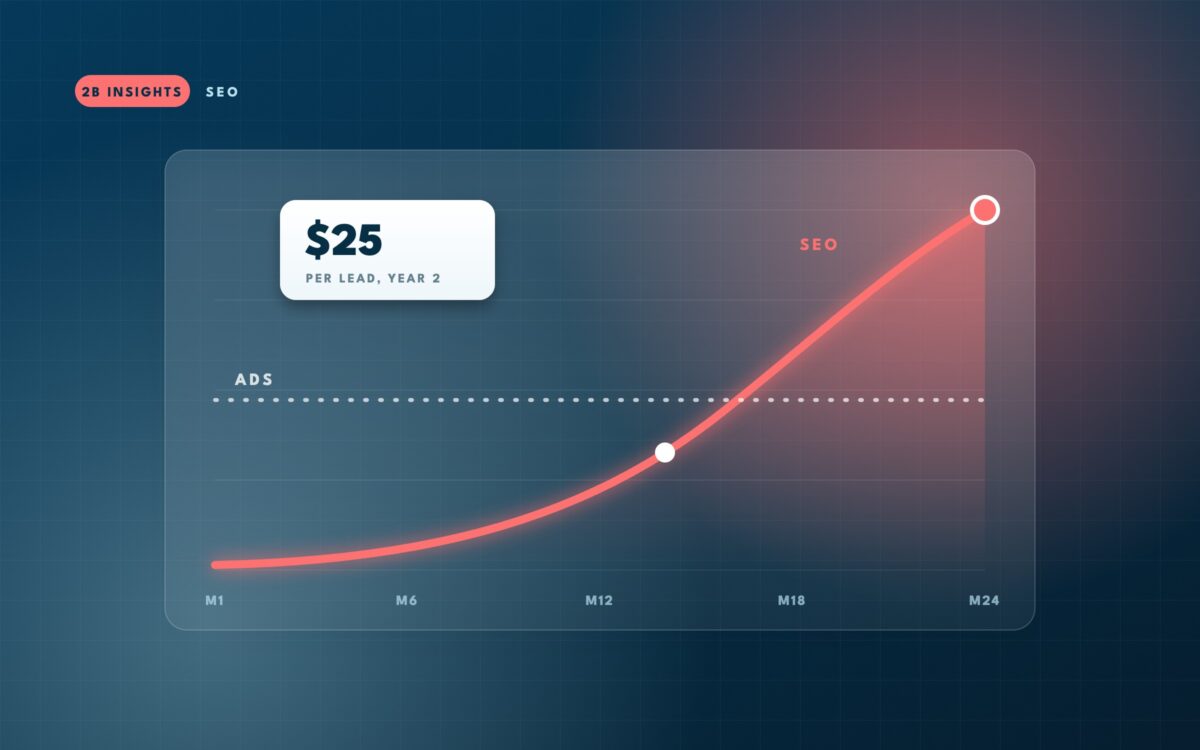
You will often hear SEO described as “free traffic.” It is an appealing idea, and it is not quite true. Good SEO takes time, skill and steady investment, whether that is your own hours or someone else’s fees. What is true is that SEO behaves completely differently from paid ads over time, and once you see the math, it becomes much easier to decide how much of each your business needs.
This post walks through a simple, hypothetical model for a local business comparing ads and SEO over two years. The numbers are illustrative, but the shape of the curve is one we see again and again.
- Ads are like renting: results start fast and stop when you stop paying.
- SEO is like building equity: slow at first, then each month gets cheaper.
- Cost per lead from SEO typically starts high and falls over time.
- Most local businesses do best running ads now while SEO builds underneath.
Renting versus owning
Paid ads
- Leads can start within days
- You pay for every click
- Costs rise as competitors bid more
- Traffic stops the day you pause
SEO
- Results take months to build
- No cost per click
- Rankings and pages keep working
- Traffic continues if you slow down
Neither is better in every situation. They solve different problems. Ads solve “I need customers this month.” SEO solves “I want customers to keep finding me without paying for every visit.”
A two-year model
Imagine a family law practice in Queens weighing two options. These numbers are made up for illustration, and your market will be different, but the comparison holds for many local businesses.
Option A: Google Ads. $3,000 a month, producing about 30 leads a month at roughly $100 per lead, starting almost immediately.
Option B: SEO. $2,500 a month for the first year to build service pages, content, reviews and local links, then $1,000 a month to maintain and grow. Leads start slowly and rise as rankings improve.
| Period | SEO spend | SEO leads | SEO cost per lead | Ads cost per lead |
|---|---|---|---|---|
| Months 1 to 6 | $15,000 | 30 | $500 | $100 |
| Months 7 to 12 | $15,000 | 144 | $104 | $100 |
| Months 13 to 24 | $12,000 | 480 | $25 | $100 |
| Two-year total | $42,000 | 654 | $64 | $100 |
In the first six months, SEO looks like a terrible deal: five times more expensive per lead than ads. By the end of the first year, the two are about even. In the second year, SEO leads cost a quarter of what ads cost. That is what compounding looks like.
Looking at the totals
Over the same two years, the ads-only option would cost $72,000 and produce about 720 leads. The SEO option costs $42,000 and produces 654. Close on volume, very different on cost. And at the end of year two, the practice running ads owns nothing that keeps working if the budget stops. The practice that invested in SEO owns dozens of pages, a strong review profile and rankings that will keep bringing in leads for a long time, even if it cuts back.
The model also leaves out a few things that usually tip the balance further. Organic visitors often convert better, because people tend to trust results they found on their own. Strong pages also make ads cheaper and more effective when they point to them. On the other side, the model assumes SEO is done well. A poorly run program can spend the same money and never reach the second-year payoff, which is why the quality of the work matters as much as the budget.
Why SEO gets cheaper over time
Three things happen as an SEO program matures.
A page written in month three about “how child custody works in New York” can keep bringing in visitors for years. With ads, a click from that same search costs the same, or more, every single time.
The formula to run for your business
Total SEO investment to date ÷ Total organic leads to date = Cost per lead
Track this number every quarter and compare it to your cost per lead from ads. To do that, you need tracking that separates organic leads from paid ones. Without it, SEO results tend to get credited to “word of mouth” or simply missed.
Good to know: Some of the value of SEO never shows up as a form fill. People who find you in search and call later, or walk in, are easy to miss. Asking new customers how they found you fills in a lot of that gap.
When the SEO math does not work
SEO is not the right priority for every business at every moment. Be honest about these situations.
- You need customers this month. A new business with no cash cushion cannot wait six months. Start with ads and build SEO as revenue allows.
- Almost nobody searches for what you sell. If your service is new or unusual, there may not be enough search demand to capture yet.
- The competition is extreme and your budget is small. Ranking for “personal injury lawyer Manhattan” takes serious, sustained investment. A narrower niche or neighborhood may be a smarter target.
- Your website cannot convert visitors. More traffic to a page that does not turn visitors into leads only makes the math worse. Fix that first.
The approach that usually wins
For most local businesses, the answer is not ads or SEO. It is ads now, SEO underneath, and a gradual shift of budget as organic leads grow.
Paid campaigns bring in leads while SEO foundations are built.
Rankings grow. Trim ad spend on searches you now rank for.
Organic leads carry more of the load. Ads fill gaps and test new offers.
Watch out: The biggest SEO mistake is stopping at month four because results look slow. That is exactly when the cost has been paid and the compounding is about to start.
Run your own numbers
Start with what you know: what you spend on ads today, what a lead costs you and what a new customer is worth. Then ask what it would mean if a third of those leads came from search instead, at a fraction of the cost, two years from now.
The harder questions are the specific ones. Which searches in your market have enough volume to matter? How competitive are they? How long would it realistically take to rank, and what would it cost? Those answers change the model a lot, and they are worth getting right before you commit a budget.
Want to see what this model looks like for your business?
We’ll plug in your real numbers, look at the searches in your market and give you an honest view of whether SEO is worth it for you right now.